

If you were to ask me what one of the most important things I have learnt while living with Fibromyalgia is, I would say pacing myself. It is something I still don’t always get right. Pacing is a conscious choice, unlike the pain, exhaustion and other symptoms Fibromyalgia can throw at you without warning. What I can control, at least to some extent, is how I respond to the energy I have available.
What Does Pacing Yourself Actually Mean?
At its simplest, pacing is about working with the energy you have available and thinking about how much different activities will use. I find it easiest to think about it using the example of your day and a battery.
The first thing to bear in mind is that, for me, it is very rare for that battery to charge all the way to 100%. On a better day you may get to 70%. On a really bad day you could be lucky to get to 30%. I am consciously using words like may and could because we are individuals and everyone’s experience is their own.
Now you have a ballpark battery level, you need to think about how much of that battery any activity will use. I find something as simple as taking a shower can use 30% of my battery, so on a bad day it is impossible and on a better day it is still a large chunk of my available resources.
However, some slow and steady diamond painting might use only about 10%. Going through my emails may use only 5%, unless there is something important that needs more mental capacity.
This brings us onto the need for both physical and mental pacing. There may be times when physically your body is saying no, but your mind feels quite sharp. Or, in my case far less often, the other way around.
Why Better Days Can Be So Tempting
After several days in a row with a very low battery, when you suddenly find yourself with a little more juice in the tank, to mix my metaphors, it is easy to think of all the things you have been unable to do. Subconsciously you may even have made lists of chores to do as soon as you feel a little better.
It feels natural to want to get on with everything, but that natural urge is better controlled, otherwise you run the risk of putting yourself back to where you were.
When Doing Too Much Catches Up With You
Problems occur when, as soon as we feel better, we throw ourselves into all the activities on our conscious or unconscious lists. When someone without a chronic illness becomes ill, they can usually give themselves a short recovery period and then get back to their usual level of health. The problem when you have Fibromyalgia or another chronic illness is that, as you recover from one bad bout, the next one may already be around the corner.
It is this knowledge that can cause you to panic and throw yourself into everything that needs doing. If we step back from the situation and look at it logically, trying to do a million and one things with already limited physical resources is a recipe for disaster and can leave you paying for it afterwards.
Learning to Let Go of the Guilt
When you are in pain or exhausted for much of the time, it is natural to feel guilty about the things you believe you should be doing when you are not well enough to do them. Many of us are brought up to take pride in having a strong work ethic, and it can be difficult to let go of those expectations when our health changes what we are able to do.
The first, and one of the most important things to do, is deal with the guilt you may be feeling. You did not ask to develop Fibromyalgia, who would for heaven’s sake. Yet it can still be very difficult not to feel guilty about the things you are no longer able to do in the same way.
Pacing Looks Different on Different Days
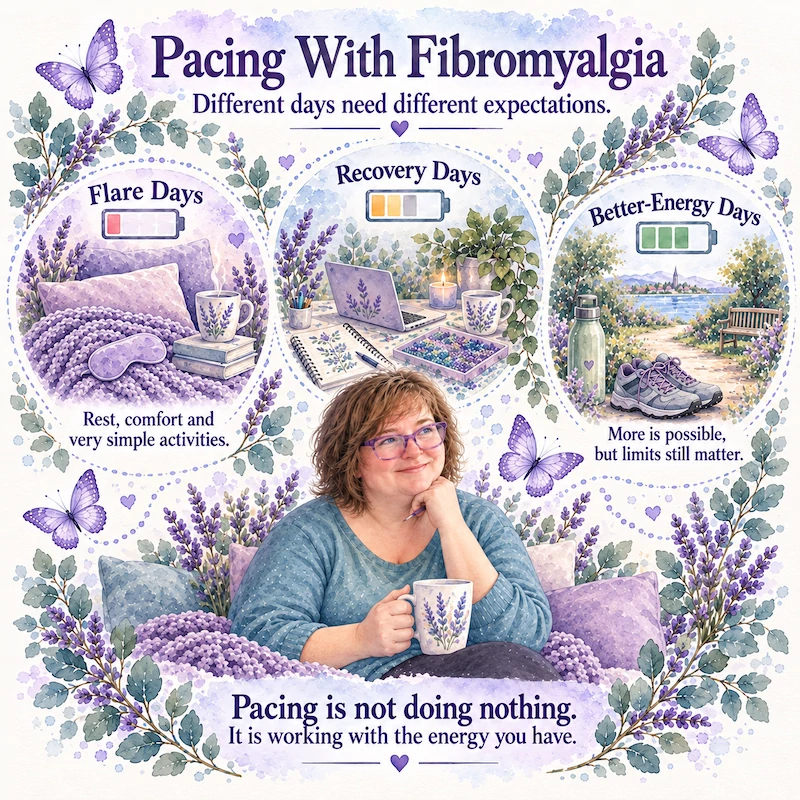
One of the things that helped me was recognising that not every day should be treated the same. Over time I began to think of my days in three broad ways: flare days, recovery days and better-energy days.
Using the battery idea, flare days are more like those 30% days, while better-energy days are closer to 70%. What I can reasonably expect from myself depends on which kind of day I am having.
Flare days
On flare days I keep things very simple. I might look through magazines on Readly, read a book on my Kindle or watch something on TV. These are all things I can usually manage without asking too much of myself.
If it is a particularly bad flare, though, even those things may be too much and I simply have to stop until I am managing a little better.
Recovery days
In many ways, recovery days are my baseline. These are the days when I can usually work on content for the blog, do some genealogy research or enjoy one of my crafts.
If my mental clarity is a bit lower, I may choose diamond painting, where the colour decisions are made for me. If my creative juices are flowing, I might choose adult colouring or cardmaking.
If I do not have too much else I want to get on with, a shower may be an option too, as long as my pain levels do not stop me climbing over the edge of the bath.
Better-energy days
On better-energy days I can look at ongoing projects like my big croffice (craft room/office) declutter. I may even consider going out somewhere, perhaps to a local shop or for a very short walk.
Even on these days, though, I know I have to be careful about how much time I give to these activities. An hour doing something like this will likely use up the majority of my day’s available resources.
Planning With Flexibility Built In
To use this blog as an example, I now plan my content well ahead so that I have a buffer. This means that if I have a bad spell, I can ‘lose’ a chunk of time and still be producing content.
I also plan some of my social media content ahead. Something like adding an Instagram Story can even be done from bed if I am having a bad day.
Sometimes the flexibility is around timing. If I have a project like making my Christmas cards, I often plan to do this in October, so if things are not going well I can bump it back a month. Equally, if I am doing well after Christmas, I have been known to start making cards for the following Christmas before we even reach the new year.
One of the biggest mindset shifts I have developed is to consider all plans pencilled in. Even something fixed like a medical appointment may need to be cancelled if I am, ironically, too ill to go to the doctors.
Sometimes Pacing Means Stopping Altogether
Back in 2017 things came to a head when I had a massive triple flare-up which lasted over three weeks. Each time I thought I was improving, I would hit the rocks again. A lot of this was to do with stress, which can have a huge impact when you have Fibro, and it resulted in me asking my employer to dismiss me. You can read more about that here. Removing the stress of the job helped considerably, but I still reverted to the habit of trying to do too much when I felt well.
I think everyone is familiar with the January blues, although on reflection that may be more of a northern hemisphere thing! Sometimes, though, that low period can last much longer.
In early 2026 I found myself physically and mentally low for a long period of time. I don’t think I even left the bedroom until about May. It was as if everything I love, blogging, genealogy and crafting, had simply gone invisible. I don’t know whether it was depression or just an extended period of very low energy and motivation, but I was happy enough with my quieter life of watching box sets and playing phone games.
Eventually those interests came back, and I was able to pick them up again.
Pacing Doesn't Mean Doing Nothing
Pacing is about finding the right balance for where you are, both physically and mentally. On the worst days that may mean doing nothing, but the rest of the time it is about being thoughtful with how you use your energy.
If there is something important you need to do that will take a lot of your resources, think about choosing less demanding activities for the rest of the day.
If something big is coming up, try to save your energy for it and also anticipate that you may well be drained for some time afterwards.
What Years of Pacing Have Taught Me
Since I have got to grips with pacing myself, life has been considerably easier. I still have awful days when very little is going to happen, and I have had to learn to accept that rather than fight against it.
I think I am nearly at peace with letting go of guilt, most of the time, and when things happen like they did at the beginning of 2026, I know I can come back and pick things up again. While I was busy redesigning the blog, I went nearly eleven months without doing any crafting, but that was okay. I had simply put some things aside for a more pressing need.
I think one of the most important things I have learnt is that everyone with Fibromyalgia is different. I used to really struggle to understand how some people seemed able to go out several times a week because I couldn’t imagine that. But equally, other people seem to have lower mental clarity than I do. Some parts of my mental battery serve me pretty well, and I can be grateful for that.