

If you have found your way to this post, I am guessing that you or someone you know might have been diagnosed with Fibromyalgia, or perhaps you are wondering if the symptoms you are experiencing could be Fibro. If so, you probably have a lot of questions.
What is Fibromyalgia?
So what is Fibromyalgia? I hear you ask.
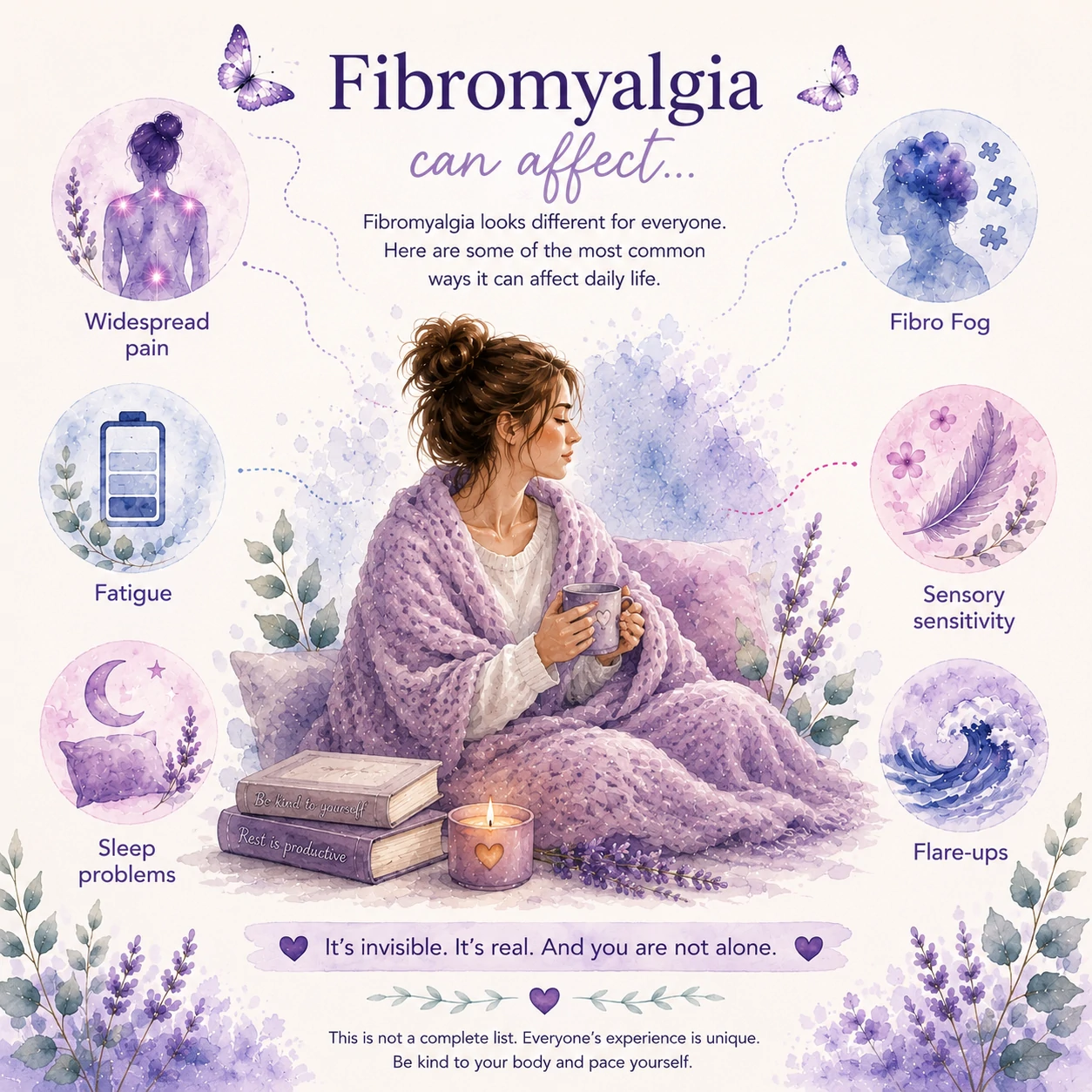
Fibromyalgia is a long-term health condition that causes widespread pain throughout the body. It can also cause fatigue, problems with sleep, cognitive difficulties (often called Fibro Fog), increased sensitivity to pain and a wide range of other symptoms.
As well as its full name, Fibromyalgia is sometimes shortened to FM and, within the community, it is regularly shortened to Fibro.
When Fibromyalgia first entered my life, I had only ever heard of one case of it, a friend’s father. Since I began living with and learning about the condition, I have heard the word mentioned much more often. However, maybe I am just more aware of it and actively looking for it, like when you get a new car and suddenly see that model everywhere.
The exact cause of Fibromyalgia is still not fully understood. Research suggests that changes in the way the nervous system processes pain may play a part. More recent research has also found evidence that the immune system and autoantibodies could be involved, potentially in some people with Fibromyalgia. This is an evolving area of research, however, and Fibromyalgia is not currently established as an autoimmune disease.
Unfortunately, that uncertainty also means there is plenty of conflicting and misleading information about Fibromyalgia online. Hopefully, I can help you make a little more sense of what Fibromyalgia is, what living with it can mean, and where you can go next for more information.
What are the Symptoms of Fibromyalgia?
Although widespread pain is probably the symptom Fibromyalgia is best known for, Fibro is about much more than pain.
Fatigue can be overwhelming, and sleep doesn't always leave you feeling refreshed. You may experience stiffness, headaches, digestive problems and cognitive difficulties, often referred to as Fibro Fog. Some people also become much more sensitive to things such as touch, temperature, light or strong smells.
One of the difficulties with Fibromyalgia is that there are a great many symptoms and not everyone experiences the same ones. The symptoms you have can also change over time and vary in severity from day to day.
This can make it difficult to know whether a new symptom is part of your Fibro or something completely unrelated. It can be tempting to think, "Oh, it's probably just the Fibro again," particularly when you already have a long list of symptoms to deal with.
However, if you develop a new or unexplained symptom, it is worth discussing it with your doctor rather than automatically putting everything down to Fibromyalgia. Other health conditions can exist alongside Fibro too.
I have gone into more detail about the different ways Fibromyalgia can affect you in Fibromyalgia and Associated Symptoms.
Is it Fibromyalgia or ME/CFS?
Fibromyalgia and Myalgic Encephalomyelitis/Chronic Fatigue Syndrome (ME/CFS) are separate conditions, but there is a considerable overlap in their symptoms. It is also possible to have both conditions.
Pain, fatigue, problems with sleep and cognitive difficulties can occur with both Fibromyalgia and ME/CFS, which is one reason it isn't always easy to tell from a list of symptoms what might be causing the way you feel.
One particularly important feature of ME/CFS is post-exertional malaise, usually shortened to PEM. This is when symptoms become worse after physical, mental or emotional activity. The worsening can sometimes be delayed and recovery may take days or longer.
This is also why I would be wary of trying to diagnose yourself from information online. Fibromyalgia and ME/CFS share symptoms with each other and with many other health conditions. If you are experiencing symptoms and don't know why, it is important to speak to your doctor so that they can look at the whole picture rather than assuming it must be Fibromyalgia.
How is Fibromyalgia Diagnosed?
One of the frustrating things about Fibromyalgia is that there isn't a simple test that can tell you whether or not you have it. There is no Fibromyalgia blood test or scan that gives your doctor a straightforward yes or no answer.
Instead, your doctor will talk to you about your symptoms, how long you have had them and how they are affecting your life. They may examine you and arrange tests to check whether something else could be causing your symptoms. The NHS explains the current process of diagnosing Fibromyalgia in more detail.
This doesn't mean Fibromyalgia is simply the diagnosis you are given when doctors can't find anything else. It is possible to have Fibromyalgia alongside another health condition, and finding one condition doesn't necessarily rule out the other.
Medical understanding of Fibromyalgia has changed over the years, and so has the way it is diagnosed. This is one reason some of the information you find online — particularly in older articles — may no longer reflect current guidance.
Getting my own diagnosis certainly wasn't a quick or straightforward experience. If you would like the personal rather than the medical version, I have shared more about what happened to me in Diagnosis: Sharing My Journey.
Who Gets Fibromyalgia?
Fibromyalgia can affect anyone. It is diagnosed more commonly in women than men, although research suggests that Fibromyalgia in men may historically have been under-recognised.
Fibromyalgia can develop at any age, although according to the NHS overview of Fibromyalgia it most commonly develops between the ages of 25 and 55.
For a long time Fibromyalgia was often portrayed as an overwhelmingly female condition. This made me curious about what it is actually like for a man living with Fibro. I reached out to a few men with the condition and asked them about their experiences, which I will be revisiting in a future post.
Is There a Cure for Fibromyalgia?
As things stand, there is no cure for Fibromyalgia. However, that doesn't mean that everyone will experience Fibro in exactly the same way or that your symptoms will always remain at the same level. You can have better and worse periods, and symptoms can change over time.
You will occasionally come across people online who say they have cured their Fibromyalgia. I would approach claims like these with caution, particularly when the person making the claim is also trying to sell you the product, supplement or programme that supposedly cured them.
I'm going to be honest with you: in my own experience, completely symptom-free days have been very rare. That is my experience though, and yours may be very different..
There are many credible people living with Fibro who have written books, created courses or shared things that have genuinely helped them manage their condition. I am not talking about them. There is a big difference between somebody saying, "This helped me and it might help you," and somebody promising that they have found the cure.
The NHS guidance on Fibromyalgia confirms that there is currently no cure, but there are treatments and ways of managing symptoms that may help improve quality of life.
How is Fibromyalgia Treated or Managed?
There isn't one treatment that works for everyone with Fibromyalgia. Managing the condition often means finding a combination of things that work for you and adapting them as your symptoms and circumstances change.
Treatment may involve support from healthcare professionals alongside approaches such as suitable physical activity, relaxation and stress management, talking therapies and learning ways to manage your activity levels. Your doctor may also prescribe medication depending on your individual symptoms and circumstances.
This can take some trial and error. Something that makes a noticeable difference to one person may do very little for somebody else, which is another reason I am wary when anyone presents one particular treatment or lifestyle change as the answer to Fibromyalgia.
For me, the more useful question has become less "How do I cure Fibromyalgia?" and more "What helps me live as well as I can with it?"
What is a Fibromyalgia Flare-Up?
When you have Fibromyalgia, your symptoms don't necessarily stay at the same level all the time. You can have better days and worse days, and a Fibromyalgia flare-up, or flare, is a period when your symptoms become noticeably worse than your usual level.
Put more simply, flares are the really bad days.
A flare might mean an increase in pain, fatigue, Fibro Fog or several symptoms at once. How long they last can vary too. Sometimes a flare may last for a day or two, while others can stretch for weeks.
My longest flare-up at the time of originally writing this post lasted from January to April 2019. It was the longest one I had experienced in three years, and certainly wasn't something I would have described as simply having a few bad days. Since then, I have had an even longer one.
Sometimes you may be able to identify something that contributed to a flare, such as doing too much, stress or poor sleep. Other times there may be no obvious explanation at all.
I have written much more about what flares can feel like and my experience of them in What is a Fibromyalgia Flare-Up?.
What is Pacing?
Pacing is about trying to balance activity and rest so that you don't repeatedly push yourself beyond what your body can cope with.
This is much easier said than done.
One of the frustrating things about Fibromyalgia is what can happen on a better day. You have felt awful for so long and then suddenly wake up feeling a little more like yourself. Instinctively, you want to make the most of it. You start catching up with everything you haven't been able to do because you don't know how long the better spell will last.
Then bang. The next day you feel horrific.
I think most of us learn this lesson more than once.
Pacing doesn't mean doing nothing or avoiding activity altogether. For me, it is more about learning to recognise my limits, breaking things into manageable pieces and trying not to use every bit of energy I have just because it happens to be available at that moment.
There will still be times when pacing isn't possible. Appointments have to be attended, unexpected things happen and sometimes life simply doesn't cooperate. It is a tool for managing Fibromyalgia, not a way of controlling every flare.
I have written more about the lessons I have learned in Pacing Yourself is Vital for Fibromyalgia.
What Does "Spoonie" Mean?
While reading about Fibromyalgia and other chronic illnesses, you may come across people referring to themselves as "spoonies". It is a term I use myself and one you will see regularly here on Creative Fibro, including in the Spoonie Life section of the blog.
The name comes from Spoon Theory, originally created by Christine Miserandino as a way of explaining what it can be like to live with limited amounts of energy. Imagine beginning each day with a limited number of spoons, with everyday activities costing you one or more of them. Someone living with chronic illness may find their supply disappearing much more quickly than a healthy person's would.
Spoonie isn't another name for somebody with Fibromyalgia. The term is used much more widely within chronic illness and disability communities.
There is more to Spoon Theory than that brief explanation, so I will be exploring where the idea came from, what it means and why so many people identify with it in a future post about spoonies.
Living With Fibromyalgia
Understanding what Fibromyalgia is and learning how to live with it are two very different things.
Fibro can affect much more than how your body feels. The unpredictability alone can make everyday life difficult. Plans may have to change, things that once seemed simple can take much more thought and energy, and sometimes you have to find completely new ways of doing things.
Over time, I have learned that living with Fibromyalgia isn't about doing everything exactly as I did before and simply pushing through the symptoms. It is about finding ways to adapt, deciding what matters most and working with the body I have now.
There is far too much involved in living with Fibro to cover in this introductory guide. I will be exploring both what Fibromyalgia can do to your body and how it can affect everyday life in more detail elsewhere on Creative Fibro.
Fibromyalgia Help in the UK
Although much of the information in this guide applies wherever you live, healthcare systems, available support and the practicalities of living with Fibromyalgia can vary considerably between countries.
As I am based in the UK, I have put together Fibromyalgia in the UK: Comprehensive Advice, where I cover information and resources specifically for people navigating Fibromyalgia here.
If you're elsewhere in the world, some of my experiences may still be useful, but it is always worth checking the current healthcare guidance and support available where you live.
Where Should I Go Next?
If Fibromyalgia is new to you, there can be an overwhelming amount to take in. You don't need to understand everything at once.
If you are trying to make sense of your symptoms, you might want to explore my other posts about Fibromyalgia and how it can affect your body. If you are beginning to work out how to live with the condition day to day, the Spoonie Life section looks more at adapting, pacing yourself and finding ways to make everyday life a little more manageable.
You can find all of my Fibromyalgia articles in the Fibromyalgia section of Creative Fibro, or head back to Start Here if you would like some help deciding where to explore next.
Most importantly, remember that Fibromyalgia affects each of us differently. What helps me may not help you, and something that doesn't work for me may make a real difference to somebody else. Part of living with Fibro is gradually learning what works for you.