
Do you have Fibromyalgia and worry about how it might affect your work? Perhaps you are doing your best to push through your symptoms, but nothing seems to be getting any easier. Believe me, I have been there.
Learning to live with Fibromyalgia is not easy, particularly when your symptoms are unpredictable. If only they could be predicted and worked around! It seems to be sod's law that you can have something really important happening on one particular day, and that is the day when you are at your worst.
However, everyone with Fibromyalgia is different. Some people have milder symptoms and are able to stay in their current occupation for the long haul. Others may need to change their hours, the way they work or eventually the work they do. Some, like me, reach a point where conventional employment is no longer sustainable.
Please don't read my story as a prediction of what will happen to you. My Fibromyalgia gradually became worse and eventually I had to make some very difficult decisions about my career. Your journey may be completely different.
What I have learnt since then is that when your health changes, sometimes work has to change with it — and that doesn't necessarily mean you've failed.
When pushing through stopped working for me
For quite some time, I battled through. I rang in sick when I needed to, returned to work when I could and tried to keep everything going.
One of the difficulties was that my health simply wasn't predictable. I could have some wonderful days and then something would happen and I would flare. Even the 15-minute commute to the office was becoming harder and, at times, the journey there and back felt harder than actually doing my job.
Then there was sickness absence and attendance management.
I completely understand why employers, particularly large organisations, need systems for managing sickness absence. My employer was a very large organisation and my manager had responsibilities to both me and the wider team. I don't blame my manager for doing their job.
But that doesn't mean the process wasn't stressful from my side of the telephone.
When you already know you've had more time off sick than anyone would like, having regular check-ins and knowing your absence is causing difficulties can create its own pressure. My Fibromyalgia didn't become more predictable simply because everybody involved wanted me to be well enough to work.
Eventually, I reached a point where it wasn't fair on me, my employer, my colleagues or the people I was there to help. After dealing with a particularly difficult period of multiple Fibro flare-ups, I very sadly asked to be dismissed.
I've written separately about why I reached the decision to ask my employer to dismiss me and about my experience of attendance management while chronically ill, so I won't repeat those stories here.
What matters for this article is what came next.
If I could no longer do the job and career that had previously been such an important part of my life, what did work mean now?
Your experience may be completely different
If you are very new to living with Fibromyalgia, please don't read about what happened to me and think that leaving employment is inevitably where you are heading.
Other people may find that they can continue working but need to make changes along the way. That might mean changing their hours, working differently, reducing some of the demands on them or moving into a different role. Later in this post, we'll look at some of the options that may help.
There will also be people whose symptoms are severe enough that paid work simply isn't possible, either for a period of time or longer term. There isn't one correct version of working with Fibromyalgia.
My own symptoms gradually became worse and eventually the job I had and the health I had were no longer compatible. That is my experience of Fibromyalgia, not a roadmap for yours.
Work means more than earning money
When I left employment, I didn't just lose my salary. I had always been career-minded, so work had been an important part of how I saw myself. It gave structure to my days, a sense of purpose and satisfaction when I had done something well. It brought me together with other people and gave me the feeling that I was contributing something.
Suddenly, I had to rethink all of that.
In the original version of this post, I wrote about the importance of work when you have Fibromyalgia. I still believe that having something meaningful and absorbing in my life is important for me, but over the years my definition of work has changed.
Paid employment, productivity, purpose and personal worth are not the same thing.
You can lose your employment without losing your skills. You can be unable to earn money and still have things that give you purpose. You can have a day when you achieve absolutely nothing and still be every bit as valuable as you were on your most productive day.
That last one can be particularly difficult to remember when you have spent years measuring a successful day by how much you managed to get done.
For me, one of the challenges of learning to live with Fibromyalgia has therefore been finding a balance. I still enjoy being productive. I like learning, creating things and having projects to work towards. Being absorbed in something I enjoy can also help take my attention away from my pain for a while.
But I no longer think everything I spend my limited energy on has to be productive to justify doing it.
Sometimes something is worthwhile simply because I enjoy it.
I had to redefine what I meant by work
Once conventional employment was no longer part of my life, I had to redefine what I considered to be work. I still needed things that gave me a sense of purpose and satisfaction, absorbed me enough to distract me from the pain and gave me opportunities to learn and be creative.
Blogging became one of those things. Creative Fibro actually began before I left employment, and over the years it has become one of my main ongoing projects. There are times when I am doing well and throw myself into it, and other times when Fibromyalgia and its associated symptoms are winning and I go a bit quiet.
I'd still love the blog and my other creative work to provide me with some income, but I've learnt that I can't physically afford to put myself under the same pressure I might have done before Fibromyalgia. I have to enjoy the process as well as thinking about where it might eventually lead.
Genealogy is another long-standing interest. I've been researching for many years and my interest stretches well beyond my own family tree into history and collaborative genealogy. It uses very different skills from blogging, but it gives me the same satisfaction of having something interesting to investigate and work towards.
Then there is crafting. Making something with my own hands gives me a different kind of satisfaction again. Underneath my computer monitor I have a £5 note that I earned from my creativity. It isn't there because £5 is going to change my financial situation. I keep it there to remind myself that my creative talents have worth.
I also spend time learning, researching, organising information and managing my own little collection of projects. Some of those things might eventually lead somewhere and others probably won't.
The important change has been realising that they don't all have to.
I can have projects and ambitions without trying to turn every interest into a business. I can use the skills I still have without expecting my body to work to somebody else's timetable. And on the days when Fibromyalgia means none of those things happen, they will still be there when I am ready to come back to them.
What about earning money?
Of course, there is one rather large difference between the things I now count as work and the employment I used to have: a salary.
I actually began Creative Fibro before I left employment and hoped that, if I did everything possible, I might eventually earn something from it. I also tried to grow my cardmaking from the occasional commission into a steadier source of income.
The reality has been rather different.
I'd still love to earn an income from the things I create, and that remains something I am working towards. But building any kind of business takes time and consistency, and consistency is particularly difficult when your available energy can change without much warning.
I also have to be careful that trying to make money doesn't turn something that works well around my Fibromyalgia into another source of pressure. There is little point escaping the demands of conventional employment only to recreate them for myself at home.
That doesn't mean I've stopped having ambitions. It means those ambitions have to fit around the reality of my health.
I'm also very aware that I have been fortunate. When I left employment, I had a husband with an income and we were able to make the decision together. Losing my salary still changed our financial situation, but I wasn't facing the prospect of having no household income at all.
Not everybody has that safety net.
If your health is affecting your ability to earn, the financial implications may have as much influence on your decisions as your symptoms do. I don't want to brush that aside with an easy suggestion to simply find something else you enjoy doing from home.
For current information about financial help and support available in the UK, I have a separate guide to living with Fibromyalgia in the UK, which I keep updated rather than trying to duplicate that changing information here.
For me, earning something from my creativity would still be wonderful. But that little £5 note under my monitor reminds me of something else too: the amount of money something earns and the value it has to me don't have to be the same thing.
Could your existing work change instead?
If Fibromyalgia is making your job increasingly difficult, leaving it doesn't necessarily have to be the first option. Before deciding that the work itself is impossible, it may be worth considering whether changing how you work could make a difference.
I'll be honest, towards the end of my time in employment one of the hardest parts of my working day was the commute to the office. It was only about 15 minutes each way, which may seem like nothing to someone without health complications, but there were times when the journey there and back felt harder than the job itself.
For somebody else, the difficult part might be their working hours, sitting or standing for long periods, not having enough opportunities to rest, particular duties or simply trying to fit an unpredictable condition into a completely predictable working day.
Depending on your job and circumstances, possible changes might include: different hours, more suitable breaks, changes to some duties, specialist equipment or working from home or possibly a work/home hybrid basis.
If your Fibromyalgia has a substantial and long-term effect on your day-to-day activities, you may meet the legal definition of disability under the Equality Act 2010. If so, your employer has a duty to consider reasonable adjustments to help reduce disadvantages you experience at work.
It is also worth knowing that asking for flexible working and asking for a reasonable adjustment because of a disability are not necessarily the same thing. Acas has current guidance explaining both, so if you think either might help, it is worth checking your options rather than assuming you simply have to struggle on.
There is also a government scheme called Access to Work, which may be able to provide practical support with things such as specialist equipment, support workers or travel to work. It does not replace an employer's responsibility to make reasonable adjustments, but it may provide additional help.
None of this means every job can be adapted to every health condition. In my own case, I eventually concluded that the flexibility I needed and the job I had simply weren't compatible.
But your situation may be different.
If there are parts of your job you still enjoy and can manage, it is worth asking whether the things that are making it unsustainable can change before assuming that your whole career has to.
If you do need something different, start with your skills
Sometimes changing how you do your existing job won't be enough. Perhaps the work is too physically demanding, the stress is unsustainable or the flexibility you need simply isn't possible in that particular role.
If you do reach that point, it can be difficult to see beyond the career you already have.
We all have a much larger skill set than we are usually aware of. Quite often we define ourselves in terms of what we do for a living, when in reality our job is only one place where we happen to use some of our skills.
Think beyond your job title. What are you actually good at?
Perhaps you organise people, explain complicated things clearly, solve problems, work with numbers, write, research, create, listen, teach, plan or have specialist knowledge you've built up over many years. There may also be skills you've developed through hobbies, volunteering, caring responsibilities or simply life that have never appeared on your CV.
Leaving a particular occupation doesn't make those abilities disappear.
The difficult part is then considering which of them you could use in a way that works better with the health you have now. That might mean a different role, fewer hours, working from home, self-employment or something you haven't considered yet.
If you are struggling to identify your skills, there is help available. In England, the National Careers Service has a free Discover your skills and careers assessment which can help you think about what you enjoy, what you're good at and careers that might use those strengths. Scotland, Wales and Northern Ireland have their own careers services.
You don't have to come away from that exercise with a completely new career plan.
Sometimes the useful first step is simply recognising that “I can't do the job I used to do” and “I have nothing left to offer” are two very different statements.
What if I'm too ill to work?
You may have read the previous sections and thought, “That's all very well, but I'm simply too ill to work.”
And that could easily be your reality.
We are all different, and our Fibromyalgia symptoms are different too. There will be things that some of us can manage while others can't. There may also be times when something you could manage last year, last month or even last week is simply beyond you today.
This post isn't here to tell you that if you just find the right job, work from home or discover the right transferable skill, everybody can find a way to keep earning. Sometimes your health doesn't allow that.
I had to make the painful decision that I could no longer continue in conventional employment. Although I've since found other things that give me purpose, that doesn't mean somebody else has to follow the same path.
There can be a lot of pressure in our lives to be productive and to measure what we contribute by what we earn or achieve. When illness has already taken away things you once took for granted, it can be very easy to turn that pressure on yourself. I did that for so long, it simply felt baked into me.
Rest is not something you have to earn by being productive first.
If today your body needs your available energy simply to get through the basics of the day, then that is where your energy needs to go. Your circumstances may change in the future or they may not.
Either way, being unable to work does not make you less valuable than somebody who can. I understand that some people in society may hold that view, but it is easier to tune out the noise and find the people who see your worth.
Finding purpose when paid work isn't possible
If paid work isn't possible, you may still want something in your life that gives you a sense of purpose. What that looks like is going to be different for everyone.
For me, creativity, blogging, genealogy and learning all help to fill that space, and on the worst days even bingeing a box set and losing myself in an alternative reality for a time can bring relief. They give me things to look forward to and something interesting to lose myself in when I have the energy.
For somebody else it might be spending time with family, looking after a pet, volunteering when health allows, learning something new, tending a garden, enjoying a hobby or being the person a friend knows they can talk to.
None of those things has to become a substitute career.
I think that is something I've gradually learnt over the years. When I first stopped conventional employment, I was very focused on what I could do next. Could I make money from blogging? Could I sell more cards? What else could I turn my skills towards?
There is nothing wrong with those ambitions — I still have plenty of them — but not everything needs an outcome.
Sometimes I craft because I want to make something. Sometimes I research something simply because I'm curious. Sometimes I play a little game on my phone because I fancy playing a game on my phone.
None of it needs adding to a CV. What the heck, I no longer possess a CV.
Living with Fibromyalgia has meant adapting to many things I wouldn't have chosen. Finding things that interest me, absorb me or bring me a little joy hasn't replaced the career I lost, but it has helped me build a life that contains far more than simply being ill.
When work has to change
When I originally wrote this post, I talked a lot about not letting Fibromyalgia win. I think I looked at being productive as one of the ways I could fight back against everything the condition had taken from me.
I understand why I felt that way, but my thinking has changed.
Sometimes adapting isn't giving in. Sometimes stopping something that is making you worse is the sensible thing to do. And sometimes accepting that your life needs to work differently takes far more courage than continuing to push through.
I still love being productive. When I am occupied and focused on something I enjoy, I can become completely absorbed in it. Have you ever been in pain, then lost yourself in a programme on TV, a book or something you're creating and realised for a little while that you weren't thinking about the pain?
That still happens to me.
But I don't need to be productive every day to prove that Fibromyalgia hasn't beaten me.
My career ended, but my interests, skills and curiosity didn't end with it. Over the years I've found different ways to use them, and what I am capable of doing continues to change depending on what my health is doing.
In a lot of ways, my 2026 plans began in May. It took until then to properly leave the bedroom and go as far as the room next door. The 2019 version of Susan would have felt guilty and probably fought the Fibromyalgia more, resulting in further pain alongside the exhaustion. Fibro has taught me to be pragmatic.
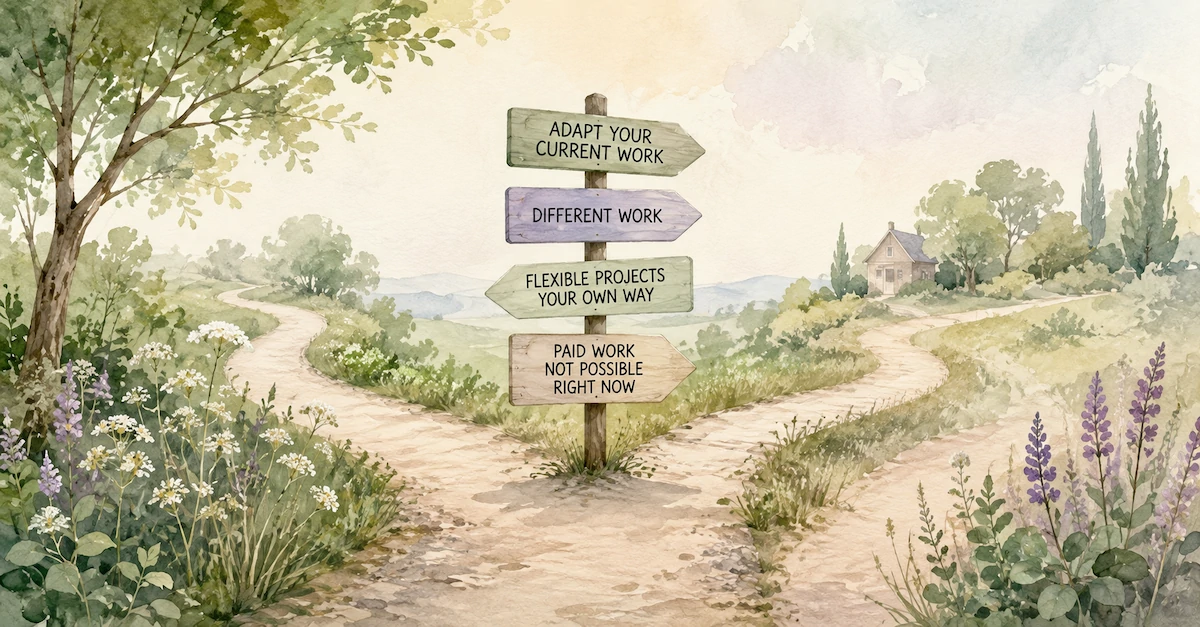
Working with Fibromyalgia isn't necessarily about finding a way to keep doing what you did before. It might mean making adjustments so you can continue in your existing job. It might mean changing jobs, reducing your hours or finding a different way to earn. It might mean reaching a point where paid work simply isn't possible.
For me, it has meant learning to build what I want to do around the health I actually have rather than constantly expecting my body to fit around what I think I should be doing.
I'm still learning how to do that.
But perhaps that is the real meaning of working with Fibromyalgia rather than constantly working against it.